
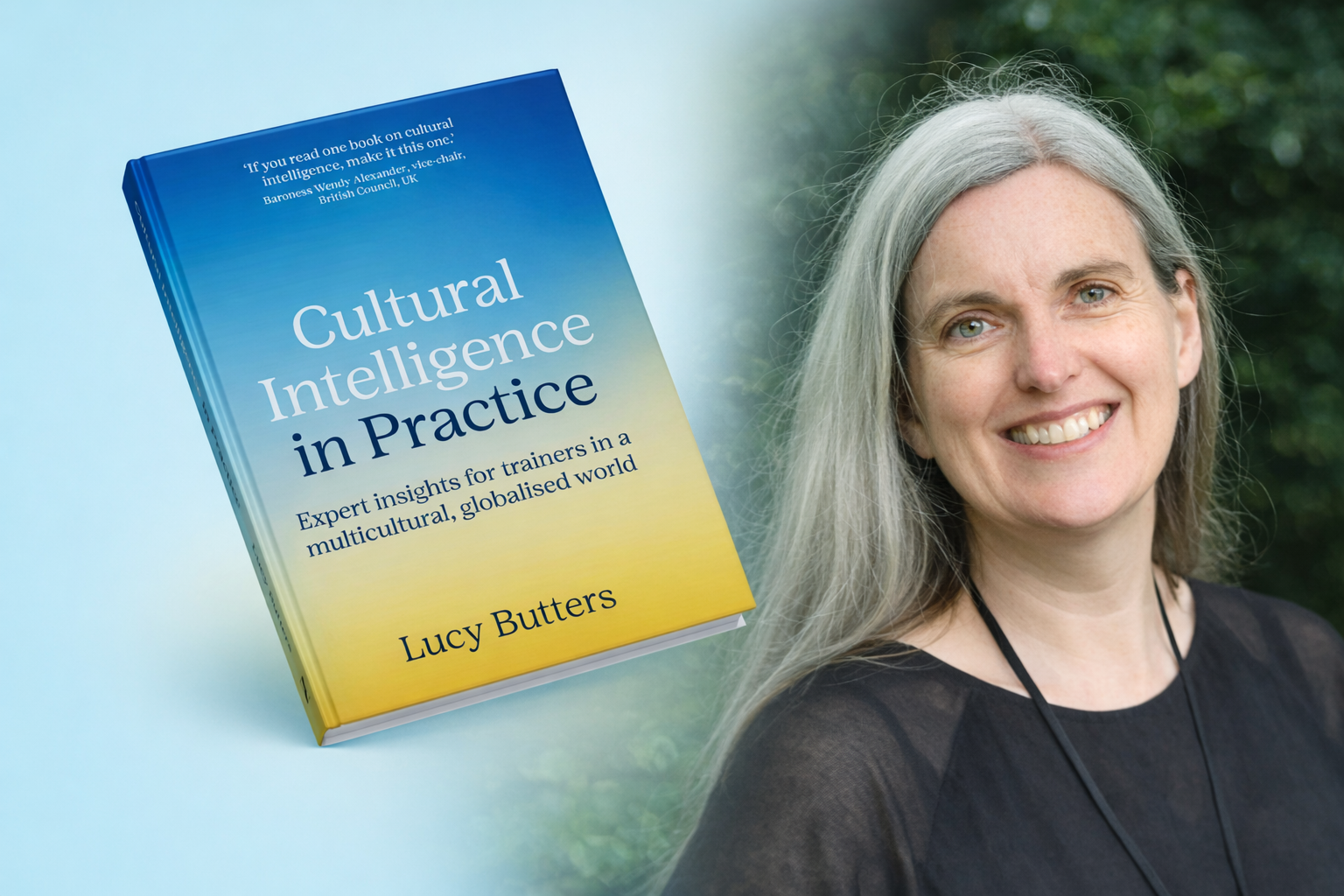

I first met Lucy Butters, author of Cultural Intelligence in Practice when she attended a Cultural Intelligence (CQ) Certification I was leading in Scotland over a decade ago. I was immediately impressed. Lucy came to the certification with an extensive background working globally but postured herself as an enormously curious learner. She asked several questions about the validity of the assessment, research, and accreditation. I immediately knew she was the kind of person we needed to take the cultural intelligence work further.
Several year later, Lucy was one of our founding members of CQ Fellows. As part of the program, she decided to write a book to address something she often faced as an independent coach and trainer: How do others train CQ? There are people across the globe in myriad contexts and settings. Is there a way we could learn from this diverse community of trainers?
Enter Cultural Intelligence in Practice, Lucy’s new book that translates the robust research on cultural intelligence into the real world by sharing numerous insights and practical ideas for how to develop CQ in ourselves and others. Now that Lucy’s book has been out for a few months, I asked her a few questions.
What gap did you see in CQ training that made you feel this book was needed?
Over the years, I’ve received many emails from people asking how to handle challenges they experience in the training room. When I reply, I’m always conscious that I’m offering just one perspective. Many coaches and trainers work alone or in very small teams, with limited opportunity to compare approaches or learn from a wider range of experiences.
The motivation for writing the book was simple—To learn from brilliant CQ trainers around the world and make that collective insight available to anyone committed to developing CQ in others.
You spoke with CQ facilitators from different parts of the world. What surprised you most as you listened to how they approach teaching CQ in very different contexts?
The similarities surprised me most! The contextual stories were different but the issues and challenges were similar. For example, Justin Ngoga in Rwanda, Dr. Sandra Upton in the US, and Dr. Anindita Bannerjee in India all spoke about how people in power, such as those in senior leadership roles at headquarters, often fail to engage and learn from their organisational diversity. To me, this spoke to our shared humanity and the different ways we end up creating similar challenges.
In many organisations, developmental opportunities are siloed and people are separated by role, location, or seniority. Some of the most valuable learning I’ve seen is when people can share experiences across those differences because it opens different perspectives on shared challenges.
This is exactly what the interviewees did. They opened different perspectives on shared challenges. The conversations reinforced the value of diverse learning networks. As a result, Dr Lyla Kohistany and I are launching a global network in 2026 for trainers and facilitators working across cultures (more information at https://www.crossculturalcatalysts.com/).
What’s one thing you’ve changed in your own facilitation because of the facilitators you interviewed?
I have a renewed sense of clarity and conviction as a facilitator. That matters because participants need to feel they’re in safe hands. It also reinforced the value of continually investing in a community of practice, at every stage of development. Reflecting on the conversations with these trainers gave me an unexpected boost of confidence.
I’ve also become more intentional in my design. Many interviewees said behaviour change is the hardest part to develop and to inspire in others. That prompted me to experiment more, including how I open sessions and by building in more moments of constructive discomfort within a safe environment. Knowing what to do is not the same as being able to do it; changing habits can be hard and takes practice.
How do you design CQ sessions with enough structure to ensure you cover all the content, while leaving space for culturally different ways of processing and participating?
The first stage of designing a session is understanding the purpose. Once I know that, I might only need one question to start a facilitated discussion, or it might require a three-day development programme with coaching. I consider what can be left out and I create flexible buffer zones, such as Q & A times, individual quiet reflection times, or group games. This kind of approach helps you flex and respond to needs with different groups.
Whatever content you are sharing, know what the key priorities are and be prepared to let go of content you’d planned if the group needs more time with a key aspect. No two groups of people you work with respond the same, even when on paper they seem very similar.
Who did you have most in mind as you were writing this book, and how do you hope it will be used in real-world CQ work?
The book speaks directly to practitioners working to build inclusive, internationally effective organisations and engaged communities. Its ambition extends beyond individual learning to equip those who influence others. I wrote it with trainers, coaches, educators and anyone who develops people in mind.
How, if at all, has AI changed how or what you teach in a CQ session?
When I interviewed the CQ trainers in 2023 no one was really speaking about AI and it did not feature in my interview questions. By 2024 I rarely worked with a group who didn’t ask questions about AI.
Fortunately, Dr. Lyla Kohistany agreed to write a guest chapter on CQ training and AI. She covers a variety of themes ranging from using AI for research and training needs analysis to using virtual reality in the training room.
For myself, I see AI as another cultural frontier which we need to apply CQ in order to use it well.
You have a gift for asking powerful questions. How do you intentionally use questions when facilitating CQ, and what guidance would you offer facilitators who want to sharpen that skill?
Thank you, David. I think of asking good questions not as a “gift”, but as an intentionally developed skill.
Two things really helped me develop the skill of asking questions. One was doing immersive leadership development work, including a programme across nine Arab countries and Scotland, where we spent several days just on how to develop questioning skills. The other was completing a coaching diploma. I highly recommend coaching training. Listening and questioning are inseparable and both are shaped by culture. Who gets heard? Is the question designed for speed, or for understanding?
In CQ facilitation, I think about the ART of questions: the Aim, the Relationship, and the Timing. Every question moves people somewhere, so be intentional about direction and impact.
For facilitators wanting to sharpen the skill:
- Study how questions are constructed.
- Notice if there are assumptions inside them.
- Collect great questions.
- Reflect on the ones you’re asked and how they impacted.
- Read chapter 9 on questioning and listening in my book, Cultural Intelligence in Practice.
The questions you ask influence the direction people take in their thinking. It makes them super important.
———–
Thank you to Lucy for providing us with this valuable resource to improve the ways we develop CQ in ourselves and others. It’s an easy, practical read and one that CQ practitioners everyone will benefit from.