

Sapiens author Yuval Noah Harari says, “This is the first time in history nobody has any idea what the world will look like in 10 years.”
Sam Altman, CEO of Open AI, agrees. “The fear and anxiety about AI is justified. We are in the process of witnessing the largest change to society in a long time, and perhaps ever.”
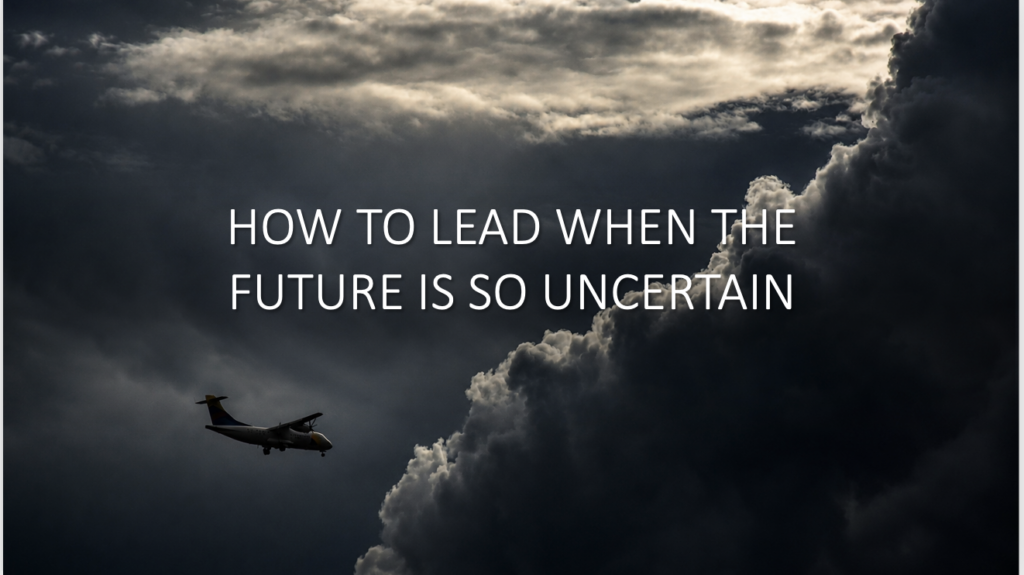
I’m always a bit reticent to jump on the “We’re living in unprecedented times” bandwagon. But something is different about our current reality. Executives tell me it feels like they’re flying the plane without knowing the destination. Colleagues and I talk about the uncertainty surrounding the business and education models we’ve built. And as a dad, I’m not sure what kind of advice to give my kids as they wonder what the future looks like for their careers and lives.
Many of the leadership instincts that worked during previous periods of change are woefully inadequate today. Projecting confidence, accelerating communication, or pushing harder for alignment doesn’t create trust or stability. Even our work in cultural intelligence needs to evolve to address current realities.
Findings from our ongoing research on global leadership effectiveness suggest that the most effective leaders are helping people make sense of ambiguity, manage cognitive and emotional overload, and navigate realities that are shifting faster than anyone fully understands. I want to briefly explore the scope of uncertainty that leaders are navigating, the vastly different ways people experience uncertainty, and how an expanded form of cultural intelligence can help us lead into the unknown.
Uncertainty in every direction
One of the consistent refrains from the leaders I talk with is that today’s leadership context is a polycrisis environment. They manage multiple crises simultaneously, often at breakneck speed. One senior manager at an international biotech company told me, “I never used to pay much attention to geopolitics, but now I have to.” She leads a functional group that includes Danes and Americans. Some of the Danes asked how she planned to address Trump’s rhetoric about Greenland. It hadn’t occurred to her that she should weigh in on something that felt so far removed from her industry and expertise, but the team was looking for guidance. And this was on top of managing a reorg, ensuring the team met critical deadlines, and trying to prevent the loss of a major customer following a recent product malfunction.
In another focus group, a senior healthcare executive in Europe described spending a significant amount of time scanning geopolitical developments to assess downstream implications for medication costs, staffing, and public backlash around social issues. He knew the war and rising fuel costs along with the DEI backlash in the US would eventually be felt directly in EU healthcare systems. Leaders like him find themselves navigating issues that once sat far beyond the boundaries of their formal role or expertise.
Add to these pressures the ubiquitous uncertainty created by AI, where managers are pressured to increase the use of AI across their teams while privately wondering whether they are working themselves out of a job. The Financial Times recently reported on “tokenmaxxing,” where employees at companies like Amazon artificially increase their use of internal AI tools to appear more engaged with AI adoption than they actually are. Managers are expected to calm employee anxiety while simultaneously managing their own uncertainty about where all of this is headed.
These forces, along with myriad others, create a level of uncertainty that permeates nearly every aspect of organizational life. The question is how culturally intelligent leaders navigate this uncertainty personally and with their teams and customers.
Differences in how we experience uncertainty
One time a colleague and I landed in Liberia shortly after the civil war. The streets were filled with UN vehicles. I said to him, “Seeing the heavy UN presence makes me feel safer.” He laughed heartily and replied, “The fact that they need to be here is precisely why I don’t feel safe.”
We all share some universal aversion to uncertainty. Predictability helped keep our ancestors alive. By anticipating weather patterns, food supplies, and threats from neighboring groups, they were more likely to survive. Without an ability to anticipate what might happen next, our brains move into threat mode. This creates enormous cognitive and emotional load, which becomes especially acute for managers navigating not only their own anxieties, but also the fears of their teams and the pressures coming from senior leadership.
Some individuals, however, are significantly more stressed by ambiguous situations than others. In the research that led to PRISM, a framework that classifies the top five points of friction experienced on teams, we found a consistent tendency toward greater risk aversion among certain populations. This included neurodiverse individuals, people in roles like legal compliance and engineering, and individuals who grew up in high uncertainty avoidance cultures such as Germany or Japan.
We often underestimate how profoundly people differ in their tolerance for ambiguity and change. Some team members are energized by experimentation, novelty, and speed while others find that exhausting and unsettling. There are also significant differences in what helps people manage the anxiety created by uncertainty. Some team members want leaders to project confidence, optimism, and calm. Others want transparency, even if it includes bad news.
Too often leaders are given universal prescriptions for how to provide calm amid uncertainty and change, many of which reflect Western assumptions. Culturally intelligent leaders adapt how they help people process uncertainty based on the very different ways individuals experience risk, ambiguity, and change.
Leading through uncertainty with an expanded form of cultural intelligence
Historically, cultural intelligence has predominantly focused on helping people work across national, ethnic, and organizational differences. That remains essential. But today’s leadership environment also requires a form of cultural intelligence that enables leaders to make sense of rapidly shifting realities, anticipate emerging risks, and help people navigate the organizational, technological, political, and human systems colliding around them.
In our ongoing research on global leadership effectiveness, several practices consistently emerge among leaders who appear to navigate uncertainty with more cultural intelligence than their peers:
1. Reduce cognitive load
One of the core capabilities of cultural intelligence is what we call CQ Drive—the motivation for working with people from different backgrounds. In today’s environment, we need to expand how we measure and develop motivation by considering how information overload, speed, and continual change affect people’s engagement and energy. Uncertainty consumes cognitive and emotional bandwidth. Practices like turning off notifications, creating periods away from email and news, and establishing clear boundaries for working around the clock are practical ways to reduce cognitive load.
Leaders can also introduce frameworks and mental models that help colleagues and customers make sense of complexity. For example, the Stoics’ insights on our Circle of Control help us divide energy and attention into three areas: What I can control (my attitude, reactions, habits, and work), What I can influence (team dynamics, project outcomes, organizational decisions), and What I can monitor (external events, geopolitics, the economy). Frameworks like this help redirect energy away from spiraling speculation toward constructive action.
2. Give agency where possible.
Preliminary findings from our research demonstrate a stark contrast in the confidence and engagement of leaders and teams who have some agency over decision-making and how they approach their work. This becomes another important extension of CQ Drive for leading through uncertainty. One’s desire for autonomy varies according to personality, culture, and the individual’s PRISM orientation, but nearly everyone wants some ability to influence their environment and work. Even when organizational priorities are fixed, leaders can often provide agency around implementation, work rhythms, problem-solving approaches, or local decision-making. People tolerate uncertainty better when they feel they have influence over some aspect of it.
3. Scan for risks and opportunities
CQ Strategy, the ability to make sense of and plan amid culturally complex situation, is a superpower of culturally intelligent leaders. Culturally intelligent leaders don’t try to predict every crisis, but they do create disciplined practices for noticing emerging risks early enough to adapt thoughtfully rather than frantically. This includes setting aside time for strategic scanning, identifying a handful of key variables to monitor, engaging diverse perspectives, and conducting scenario planning exercises. The goal is less about prediction and more about preparedness. Many executives we interviewed emphasized the importance of creating organizational cultures that regularly model risk scenarios and anticipate multiple possible futures, which leads to one final critical practice.
4. Build a resilient culture
One of the most important things culturally intelligent leaders can do to manage uncertainty is to create a resilient, agile culture. But there’s often an inverse relationship between developing a psychologically safe, high-performing culture and the pace of change and uncertainty. Many managers have to implement reorganizations that were decided by senior management. They try to assure the remaining team that while painful, the changes will create future opportunities. In reality, managers know this often means asking team members to do more work with fewer resources. Employees can handle difficult realities. What erodes trust is when leaders project certainty that they themselves do not feel or when they repeatedly communicate optimism that is disconnected from reality.
In periods of chronic uncertainty, a culturally intelligent organization becomes the infrastructure that helps teams absorb instability without fragmenting trust. This means institutionalizing norms and policies that support psychological safety, constructive disagreement, and the ability to raise concerns early. One of the challenges is that leaders often feel far more psychologically safe than the people they lead. Culturally intelligent leaders create routines and norms that surface concerns early and reward intellectual honesty so teams can navigate uncertainty without losing trust in one another.
Leading into the Unknown
I remain convinced that cultural intelligence is essential for successful leadership. But CQ needs to evolve beyond interpersonal effectiveness toward helping leaders navigate multiple crises simultaneously while creating trust, stability, and calm even when they themselves aren’t sure what’s coming.
We all feel the weight of mounting uncertainty, me included. Many assumptions that gave us a sense of predictability and stability no longer feel secure. Our research findings give me hope but more than that, I derive optimism from doing this work with my colleagues and friends at Boston University, the Society of CQ Fellows, and with friends in myriad contexts across the world. This is ultimately a deeply human pursuit, and wrestling through these questions with people I care about often gives me more calm than the findings themselves.